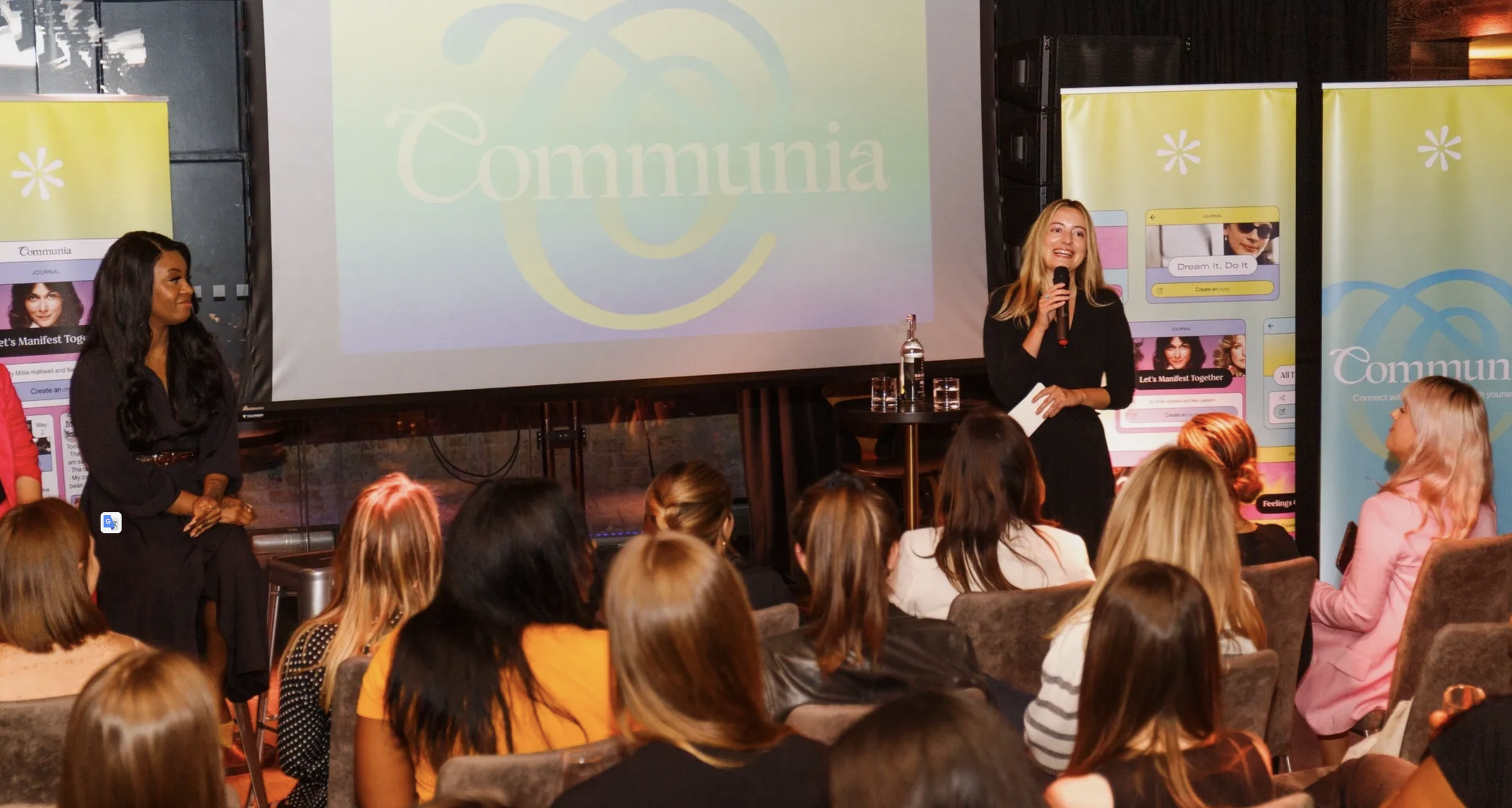
Speaking
Keynotes on the future of social media, women's safety online and off, and what it takes to survive trauma, then build something better from inside an industry that wasn't designed for us.
Currently booking Spring and Fall 2027.
Book Olivia
I'm one of the few founders building inside the social media industry while publicly holding it accountable. I speak from rare ground: as a survivor, as a researcher who has authored two landmark studies of women's social media experiences in the US and UK, and as a CEO building the platform I once needed.
My research helped shape the UK Online Safety Bill. My work has been covered by BBC News, People, TechCrunch, Forbes, Harper's Bazaar, Glamour, Ms. Magazine, Cosmopolitan, and more. I've spoken at Harvard, USC's Own It alongside Gloria Steinem, British Parliament, and ethical tech and AI events across the US and UK.
I work with universities, corporate ERGs, conferences, and policy organizations on talks that go beyond the usual "social media is bad" framing into what actually needs to change, and what it looks like when someone creates better. The below four are my regular keynotes. Custom talks built around a specific audience, topic, or moment are available on request.
-
Why recommendation systems systematically harm women, and what the next generation of platform design will have to fix.
Most conversations about social media harms treat the algorithm as a black box. I open it up. Drawing on Communia's research with over 2,000 women across the US and UK, this talk maps the specific mechanics of how feeds escalate misogynistic content, how cyberflashing and AI-generated NCII have become predictable algorithmic outputs, and why the women's safety crisis online is a business decision, not a technological inevitability. I close with what platform accountability actually looks like, beyond moderation, at the design layer.
Best for: tech ethics conferences, policy events, university lectures, journalism schools.
-
Why 51% of social media users are the most underserved market in tech, and what changes when you build for them.
Women are leaving the major platforms. 32% have left an app entirely over safety. 40% of Gen Z and millennial women have planned to leave social media altogether. This isn't a values problem. It's a market signal every consumer company should be reading. I walk corporate audiences through the data, the regulatory landscape (UK Online Safety Bill, EU DSA, US state laws), and the practical decisions any platform, product, or brand can make to take women's safety seriously without compromising growth.
Best for: corporate keynotes, women's ERGs (Women's History Month, IWD, SAAM), marketing and product summits.
-
Why values aren't a tradeoff with growth, and the counter-playbook that proves it.
Every founder gets told that mission and scale are a tradeoff. That you have to compromise the first to achieve the second. Communia has proven the opposite. The reason we're growing while the major platforms bleed women is not in spite of our mission, it's because of it. And the incumbents are structurally locked out of competing with us, because the business models that made them giants won't let them. This is true even in AI: the models that are actually safe and useful are the ones built with values-led design choices and training data. Mission shapes the model. But mission as a moat only works if you let it shape how you actually run the company. Communia is a real business with real users because we said no to almost every default Silicon Valley handed us: don't hire fast, don't chase virality, don't raise from tier-one VCs, don't lead with metrics. And we especially refused the advice handed to every woman founder: niche down. Telling women to niche down is treating half the global population as a special interest group. It's the most expensive bad advice in tech. This talk lays out the case that values aren't a marketing layer. They're the most underused competitive lever in tech, from products to AI to who you build for. And the specific operating decisions that turn the thesis into a real business.
Best for: founder events, AI ethics conferences, MBA programs, accelerators, women in business summits.
-
A survivor advocate's perspective on what we owe each other online, and what it took to find joy again.
At 19, I was sexually assaulted. When I reported it, my abuser sued me for millions in a defamation case designed to silence me. The internet that should have been my community became another site of harm. Communia is the answer I built. In this talk I share my story, the assault, the lawsuit, the isolation, and the choice to build instead of disappear, alongside what I've learned from the hundreds of thousands of women who have since told me their own. It is the talk I most regret needing to give, and the one audiences remember most.
Best for: SAAM (April) campus events, DV Awareness Month (October), women's centers, survivor advocacy conferences.
-
Why the loneliness epidemic isn't the male crisis it's been framed as, and what's collapsing in female friendship that no one is naming.
The loneliness epidemic is mostly talked about as a male crisis. The data tells a different story. Women are just as lonely. We've just been told we aren't, because the cultural script insists we have more friends than we actually do. Young women in particular are isolated in a different way than the public conversation acknowledges, through performative intimacy: group chats, social media closeness, the constant low-grade hum of being online with people but rarely with anyone. It simulates connection without delivering it. And underneath all of it sits something the loneliness conversation rarely names: the violence against women, online and offline, that pushes us into isolation in the first place. Women who are harassed, abused, doxxed, or assaulted retreat. Safe spaces aren't a wellness perk. They're often how women come back to social life at all. This talk draws on my research with over 4,000 women across the US and UK, and on what hundreds of thousands of women on Communia have said about friendship, isolation, and what they're missing. It maps the architecture of female loneliness: comparison culture, hyper-connectivity, online and offline violence, and the silence that lets it all go unnamed. And it makes the case that female friendship isn't a wellness topic. It's the most important social infrastructure we have, it's collapsing exactly when we need it most, and rebuilding it starts with telling the truth about how broken it is.
Best for: university wellness and orientation programming, women's centers, sorority and Panhellenic events, college counseling centers, online safety summits, mental health conferences.
As seen at…
❋
The United Nations
❋
Harvard’s Berkman Klein Center
❋
British Parliament
❋
Women’s Health Horizons
❋ The United Nations ❋ Harvard’s Berkman Klein Center ❋ British Parliament ❋ Women’s Health Horizons